The Science of Habit Formation: Systems vs Goals
In 2012, a team of researchers at MIT made a discovery that would change how we understand human behavior.
They found that habits aren't just things we do—they're physical structures in our brains. Neural pathways that, once formed, operate almost entirely on autopilot.
This discovery explains something that's puzzled people for centuries: why is it so hard to change our behavior, even when we desperately want to?
And more importantly: what can we do about it?
The Habit Loop: How Your Brain Creates Autopilot
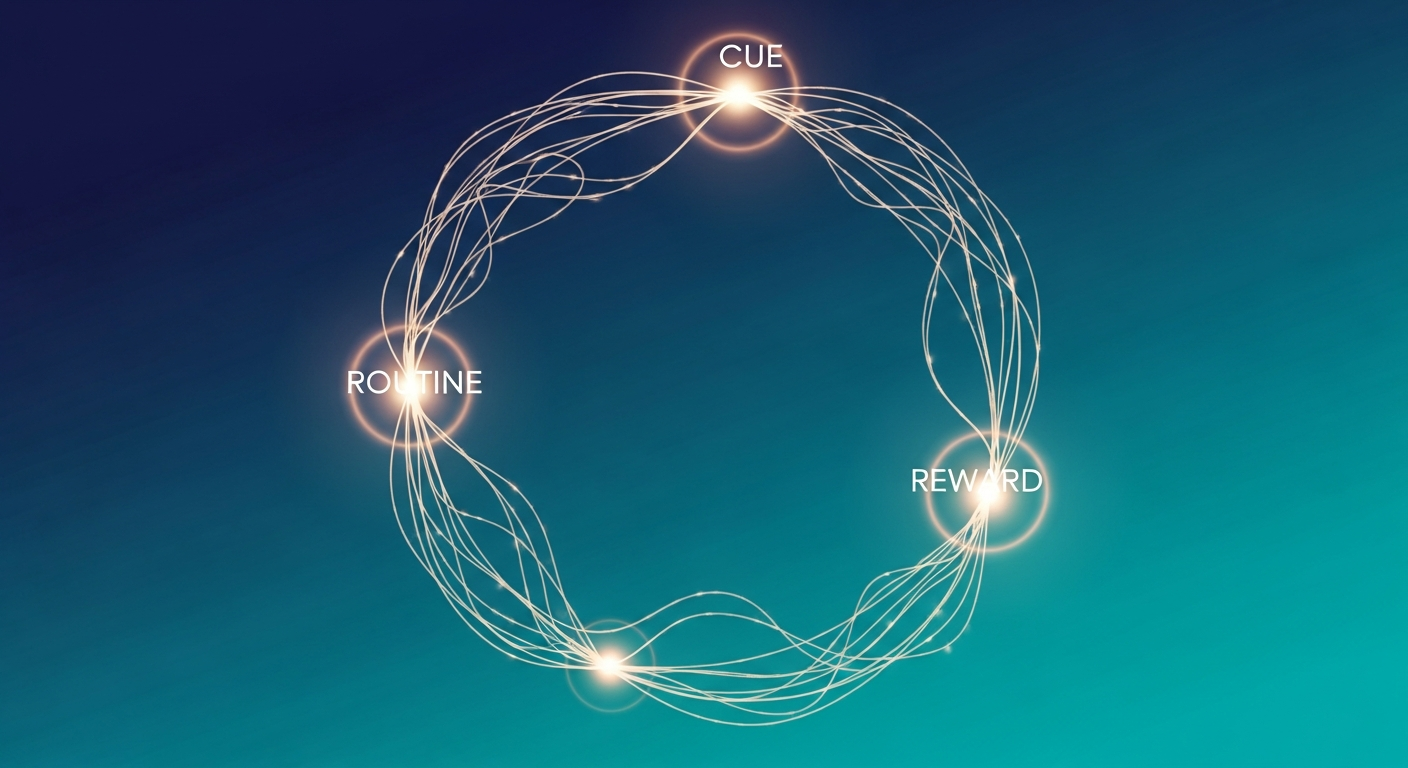
Every habit follows the same neurological pattern, which researchers call the "habit loop":
CUE → ROUTINE → REWARD
The Cue is a trigger that tells your brain to initiate the behavior. It could be a time of day, a location, an emotional state, or an event.
The Routine is the behavior itself—the action you take.
The Reward is what your brain gets from the behavior. It's what makes the habit worth remembering.
Here's the crucial part: once a habit is formed, your brain stops fully participating in decision-making. The pattern becomes encoded in a part of your brain called the basal ganglia, and the behavior becomes automatic.
This is why you can drive home from work without consciously thinking about every turn. It's why you might reach for your phone dozens of times a day without deciding to. The habit loop is running in the background.
Why Goals Fail: Fighting Your Own Brain
When you set a New Year's resolution, you're essentially trying to override these automatic patterns through sheer force of will.
Here's the problem: willpower and habits live in different parts of your brain.
Willpower operates in the prefrontal cortex—the "executive function" center responsible for conscious decision-making. This part of your brain is sophisticated but easily fatigued.
Habits operate in the basal ganglia—a more primitive brain region that's incredibly efficient but resistant to change.
When you rely on willpower to achieve a goal, you're asking your prefrontal cortex to constantly override your basal ganglia. That's like asking a tired CEO to personally approve every single transaction the company makes. It's unsustainable.
Goals require constant conscious effort. Habits run on autopilot.
This is why you can be incredibly motivated on January 1st and completely depleted by February 15th. Your prefrontal cortex can only fight so many battles.
The System Solution: Working With Your Brain
A system takes the opposite approach. Instead of fighting your brain's natural tendency to automate, you work with it.
The goal is to create new habit loops that automatically produce the outcomes you want.
Here's how this works in practice:
Traditional Goal Approach: "I want to get fit"
- Every day, you must decide whether to exercise
- You rely on motivation (which fluctuates)
- Each workout requires willpower to initiate
- One missed day feels like failure
- Requires constant prefrontal cortex engagement
System Approach: "I exercise at 6 PM every Monday, Wednesday, and Friday"
- The cue is built-in (6 PM + specific days)
- The routine is predefined (no decision needed)
- Repetition builds the habit loop
- Missing once doesn't break the system
- Eventually becomes automatic (basal ganglia takes over)
The Science of Habit Formation: What Research Tells Us
Finding #1: It Takes 66 Days (Not 21)
You've probably heard it takes 21 days to form a habit. That's a myth.
A 2009 study published in the European Journal of Social Psychology found that habit formation actually takes an average of 66 days—and can range from 18 to 254 days depending on the complexity of the behavior.
What this means for you: Don't expect instant results. Your system needs time to become automatic. Give it at least two months before you evaluate whether it's "working."
Finding #2: Missing Once Doesn't Matter
The same study found something else important: missing a single opportunity to perform a behavior did not materially affect the habit formation process.
Read that again. Skipping one day doesn't reset your progress.
This is huge because it defeats the all-or-nothing thinking that kills most resolutions. Your system should be robust enough to survive occasional misses.
Finding #3: Context Is Everything
Research from the University of Southern California found that 40-45% of our daily actions are performed in the same location almost every day.
Your environment is a powerful cue. If you want to build a new habit, anchor it to a consistent context:
- Same time of day
- Same location
- Same preceding activity
This is why "I'll read more" fails but "I'll read for 20 minutes at 7:30 AM in my reading chair with my coffee" succeeds.
Finding #4: Habit Stacking Works
Dr. BJ Fogg at Stanford discovered that one of the most effective ways to build new habits is to attach them to existing ones. He calls this "habit stacking."
The formula is:
After I [CURRENT HABIT], I will [NEW HABIT].
Examples:
- "After I pour my morning coffee, I will write in my journal for 5 minutes."
- "After I sit down at my desk, I will write my top 3 priorities for the day."
- "After I finish dinner, I will log my expenses for the day."
By linking new behaviors to established routines, you borrow the automaticity of existing habits.
Systems in Action: A Side-by-Side Comparison
Let's look at how the same objective plays out differently as a goal versus a system:
Objective: Read 24 Books This Year
As a Goal:
- January: Highly motivated, read 3 books
- February: Busy at work, read 1 book
- March: "I'm behind schedule," stress increases
- April: Miss a week, feel like a failure
- May: Abandon the goal entirely
- December: Read 8 books, feel disappointed
As a System:
- Set recurring task: "Read for 20 minutes at 7:30 AM daily"
- The cue: 7:30 AM + morning coffee (habit stack)
- The routine: 20 minutes of reading
- The reward: Progress through the book + calm morning
- Miss a day? No problem—tomorrow the task reappears
- December: The math works out to ~120 hours of reading = roughly 24 books
The person with the goal was focused on the outcome. The person with the system was focused on showing up every day.
Same objective. Completely different experience.
Building Your System: A Practical Framework
Here's how to design a system that works with your brain, not against it:
Step 1: Define the Behavior, Not the Outcome
Instead of "lose weight," define "walk 10,000 steps daily." Instead of "get promoted," define "dedicate 30 minutes to skill-building every workday."
The behavior is what you control. The outcome is what follows.
Step 2: Choose Your Cue
Pick a specific trigger for your new behavior:
- Time-based: "At 6 AM..."
- Location-based: "When I arrive at my desk..."
- Event-based: "After I finish lunch..."
- Habit-stacked: "After I brush my teeth..."
The more consistent your cue, the faster the habit forms.
Step 3: Make It Obvious
Your environment shapes your behavior more than your motivation does. Design your environment to make the right behavior obvious:
- Put your running shoes by the door
- Keep your book on your pillow
- Set your planner as your browser homepage
- Use recurring tasks that appear automatically every day
Step 4: Start Small
The biggest mistake in habit formation is starting too big. Your brain resists dramatic changes.
Instead of "meditate for 30 minutes," start with "meditate for 2 minutes." Instead of "write 1,000 words," start with "write one sentence."
The goal is to establish the habit loop first. You can increase intensity later.
Step 5: Build In Feedback Loops
Your brain needs regular feedback to reinforce new habits. Build review mechanisms into your system:
- Weekly reviews to assess what's working
- Visual progress tracking (streaks, checkmarks)
- Celebration of small wins
The Role of Technology
Here's where it gets interesting: technology can accelerate habit formation by automating the cue.
Think about it. The habit loop requires a consistent cue. But remembering to initiate a new behavior is itself a cognitive burden.
This is why recurring tasks in a planning system are so powerful. The cue is automated. The task appears on your planner every day at the designated time. You don't have to remember—you just have to respond.
It's the difference between:
- "I should try to remember to read today" (requires willpower)
- "My planner says it's reading time" (requires only compliance)
The more you can automate the cue, the less you tax your prefrontal cortex, and the faster the habit becomes automatic.
From Science to Practice
The science is clear:
- Habits are more powerful than goals because they operate on autopilot
- Your brain wants to automate behaviors—work with it, not against it
- Consistent cues are essential for habit formation
- Missing once doesn't matter—systems are robust by design
- Environment shapes behavior more than motivation does
This is why systems beat goals every single time.
A goal asks: "What do I want to achieve?" A system asks: "What would I need to do daily to make that achievement inevitable?"
The first question leads to wishful thinking. The second leads to behavior change.
Your 2025 System
You have a choice in how you approach the new year.
You can set goals—and fight your brain's natural resistance to change through willpower alone.
Or you can build systems—and let your brain's habit-forming machinery work in your favor.
The science says one of these approaches is dramatically more likely to succeed.
Choose accordingly.